Marathon Petroleum (MPC)·Q4 2025 Earnings Summary
Marathon Petroleum Q4 2025: Refining Margins Surge, Stock Jumps 6% After-Hours
February 3, 2026 · by Fintool AI Agent
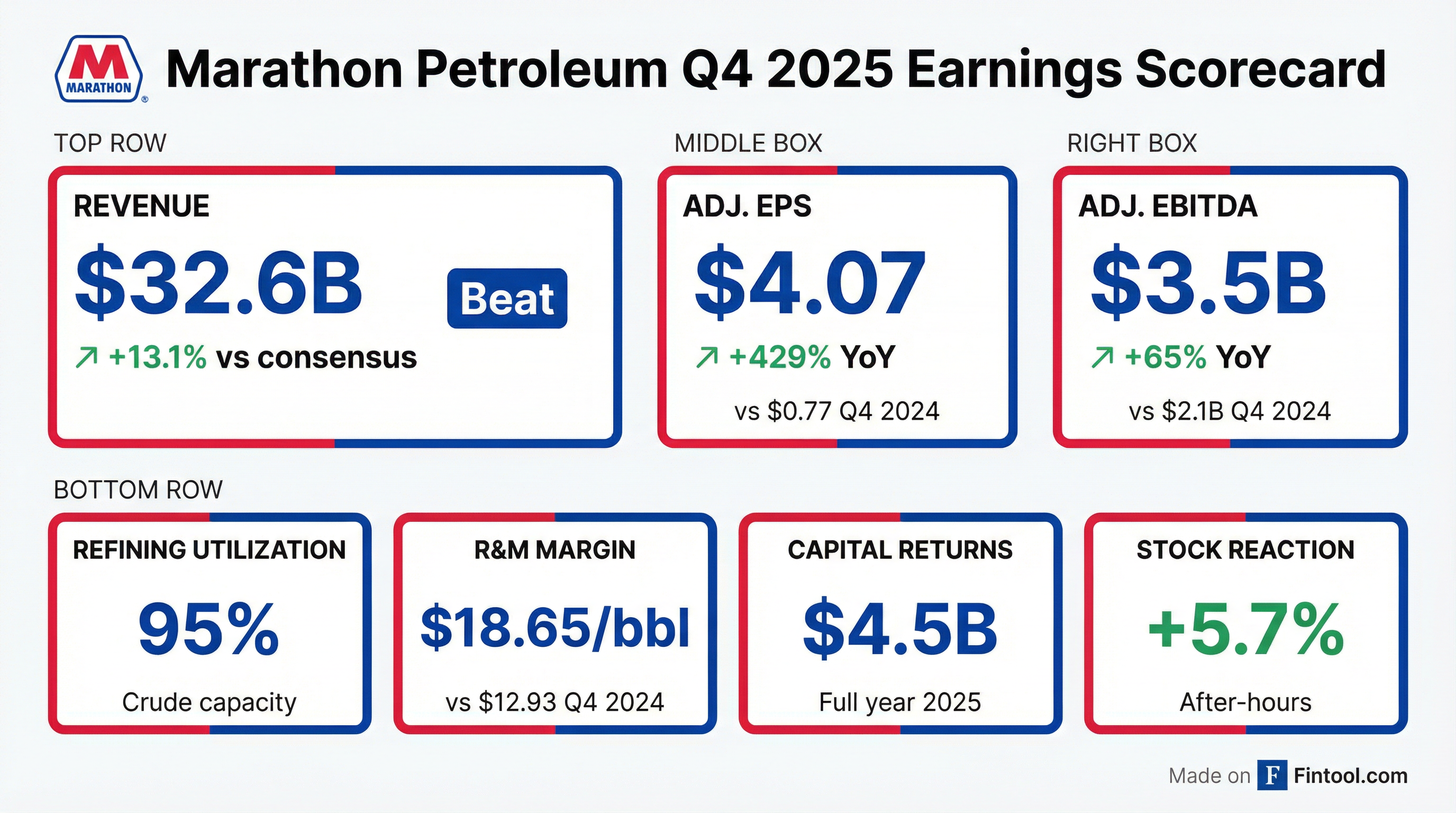
Marathon Petroleum delivered a blowout Q4 2025, with adjusted EBITDA surging 65% year-over-year to $3.5 billion as refining margins expanded sharply. The stock jumped 5.7% in after-hours trading to $186.24, reflecting investor enthusiasm for the company's cash generation and capital return program.
Did Marathon Petroleum Beat Earnings?
Revenue: Beat consensus by 13.1% — $35.8B actual vs $31.7B expected*
Adjusted EPS: $4.07, up 429% from $0.77 in Q4 2024
Adjusted EBITDA: $3.5 billion vs $2.1 billion in Q4 2024 (+65% YoY)
The massive year-over-year improvement reflects the dramatic swing in refining economics. Full-year 2025 cash from operations totaled $8.3 billion, enabling $4.5 billion in peer-leading capital returns.
 Ask Fintool AI Agent
What Drove the Refining Margin Surge?
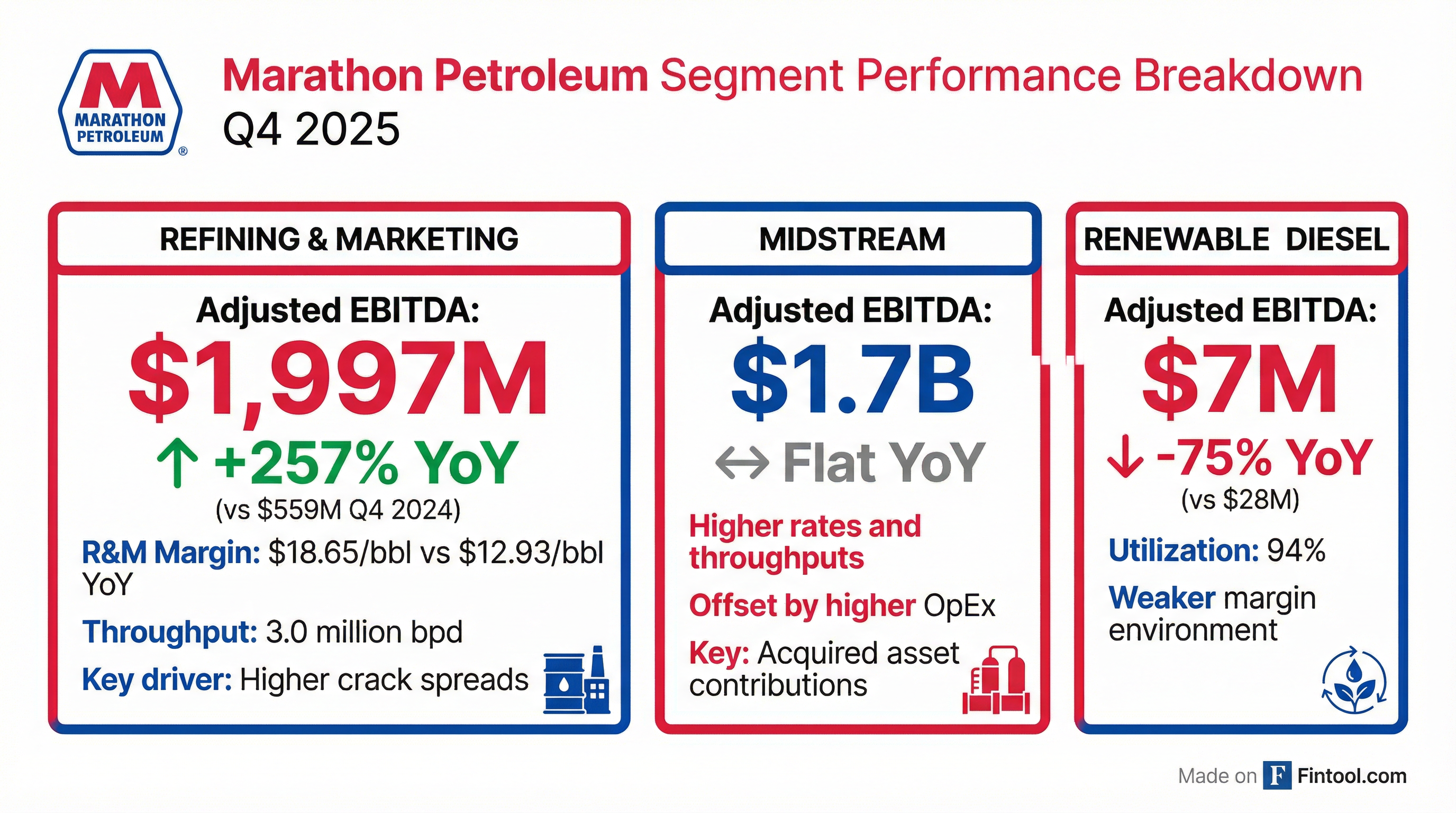
The Refining & Marketing segment was the star performer, with adjusted EBITDA jumping 257% year-over-year to $1,997 million.
Segment Performance
Key R&M Metrics:
- R&M Margin: $18.65/bbl vs $12.93/bbl in Q4 2024 (+44%)
- Crude Utilization: 95%, resulting in 3.0 million bpd throughput
- Margin Capture: 105% for full-year 2025, demonstrating strong commercial execution
Higher crack spreads drove the margin expansion, while operating costs increased modestly to $5.70/bbl from $5.26/bbl due to higher turnaround activity and energy costs.
Q4 Capture Rate: An impressive 114%, the strongest quarter of 2025, driven by solid commercial execution, favorable diesel-to-jet spreads, and strong utilization. Management emphasized this reflects sustainable structural improvements in the commercial organization.
Midstream segment performance was essentially flat YoY at $1.7 billion, with higher rates and throughputs plus contributions from recently acquired assets offset by higher operating expenses and divestitures.
Renewable Diesel continued to struggle, with EBITDA declining 75% to $7 million as utilization improved to 94% but margins remained weak.
How Did the Stock React?
MPC shares jumped 5.7% in after-hours trading following the earnings release:
- Previous Close: $176.19
- After-Hours: $186.24 (+$10.05)
The stock is trading near its 50-day moving average of $179.21, well above the 52-week low of $115.10 but below the 52-week high of $202.30.*
What Did Management Guide?
CEO Maryann Mannen emphasized the company's differentiated capital allocation strategy:
"The deployment of MPC capital enhances our competitiveness in each of the regions where we operate. In Midstream, MPLX is investing to execute its natural gas and NGL growth strategies. Growing MPLX distributions differentiates MPC from peers and supports our commitment to industry-leading capital return."
2026 Capital Outlook
A critical point: MPLX's growing distribution is expected to more than fund MPC's 2026 dividend and standalone capital — a source of differentiation for capital return.
Newly Announced Projects
MPC announced several new high-return investments:
-
Garyville Feedstock Optimization — Displace higher-cost intermediate purchases with crude. $110M in 2026, $185M in 2027. Completion by year-end 2027.
-
Garyville Product Export Flexibility — Increase flexibility for export premium gasoline. $50M in 2026, $100M in 2027.
-
El Paso Yield Improvement — Upgrade FCC and alkylation units. $35M in 2026, completion Q2 2026.
MPLX also announced the Secretariat II 300 MMcf/d gas processing plant, expanding Permian capacity to 1.7 Bcf/d by 2H 2028.
Ask Fintool AI AgentQ&A Highlights: What Analysts Asked
Venezuelan Crude Opportunity
Analysts pressed management on the impact of increased Venezuelan crude access. CEO Maryann Mannen highlighted MPC's differentiated position:
"We have the most crude optionality, optimization, sophistication, and the ability to address complex refining opportunities... If there were to be a dollar movement in sour differentials, on an annual basis, that's a $500 million benefit to MPC."
EVP Rick Hessling confirmed MPC purchased two Venezuelan crude cargoes but emphasized: "We will not be the largest buyer of Venez crudes because we have more advantageous options... we're only going to purchase anything that is economically advantaged for us."
Key stats:
- ~50% sour crude diet across system (10% higher than closest peer)
- WCS differentials widened $1-$2/bbl post-Venezuela announcement
- Canadian pipeline apportionment is a tailwind — backs up inventory and forces barrels to more expensive routes
Capital Returns: Can MPC Repeat $4.5B?
Goldman's Neil Mehta asked if 2026 capital returns could match 2025's $4.5 billion. Mannen's response was unambiguous:
"Assuming current market cracks, that would be indicative of us being able to repeat a similar pattern that we did in 2025. So yes, I think that is clearly within our ability to deliver in 2026."
West Coast Competitive Dynamics
The Phillips 66 refinery closure in California this spring is creating significant tailwinds. Rick Hessling noted:
"We used to say the region was short one refinery. Well, now it's short several refineries. We view that as a significant positive tailwind."
MPC's LA refinery completed major reliability upgrades in Q4 (intertie project, new boilers), positioning it to run hard into this favorable environment.
Garyville Investments: 25%+ Returns
On the newly announced Garyville projects, management confirmed strict return discipline:
"When we're putting capital to work on the refining side, we're looking for 25% returns here on these projects."
The feedstock optimization project will increase crude throughput by 30,000 bpd while reducing reliance on higher-cost intermediate purchases.
USW Labor Negotiations
Mike Hennigan provided an update on steel worker negotiations:
"We continue to meet with the steel workers at the international level... Our contracts did expire January 31st, but we do have rolling 24-hour extensions based on our previous contracts, which in my opinion is a good thing. It's a positive sign that we're making progress."
Ask Fintool AI AgentQ1 2026 Outlook
Q1 2026 throughput guidance of 2.74 million bpd is lower than Q4's 3.0 million bpd, reflecting seasonal patterns and planned turnaround activity (turnaround costs up 13% sequentially from $410M in Q4).
What Changed From Last Quarter?
While R&M segment EBITDA declined sequentially due to higher turnaround costs, per-barrel margins improved 16% to $18.65/bbl, and total company adjusted EBITDA expanded 6% to $3.5 billion.
Regional Refining Performance
The West Coast delivered the highest margins at $21.94/bbl (+40% YoY), while the Mid-Continent showed the largest margin improvement (+61% YoY). Notably, West Coast turnaround costs were elevated at $4.38/bbl vs $0.55/bbl in Q4 2024.
Financial Position
Cash increased $1 billion sequentially to $3.7 billion (including $2.1 billion at MPLX). The company has $4.4 billion remaining under share repurchase authorizations and maintains no borrowings on its $5 billion revolving credit facility.
Ask Fintool AI AgentDemand Outlook: Why Management Is Constructive
CEO Mannen articulated a bullish view on refined products through 2026 and beyond:
"We continue to believe that 2026 is gonna be another year of strong refined product demand... Over the next 5, frankly, over the next 10 years, you see 1-1.2% growth year on year."
On new global capacity: "There is supply coming online — an Indian refinery and an Asian refinery... about 1 million a day, but the lion's share of that capacity is really pointed toward the petchem market."
Jet fuel is a key focus. MPC is the largest producer of jet fuel in the U.S., with the LA refinery being the largest jet producer in the system, located in one of the three largest demand hubs. Management highlighted growing demand from the Department of Defense.
Key Risks to Monitor
-
Refining Margin Volatility — Q4's strong margins may not persist; crack spreads are inherently cyclical and subject to supply/demand dynamics.
-
Regulatory Risk — California's windfall profit taxes, maximum refining margin penalties, and inventory requirements pose ongoing threats to West Coast operations.
-
Tariff Exposure — The company flagged potential impacts from tariffs on crude oil and other feedstocks imported into the United States, including retaliatory actions from foreign governments.
-
Renewable Diesel Headwinds — The segment continues to underperform with weak margins, and changes in government incentives for emission-reduction products remain a risk.
-
Labor Risk — USW contract negotiations are ongoing with rolling 24-hour extensions; a protracted dispute could impact refinery operations.
Bottom Line
Marathon Petroleum delivered a strong Q4 2025, with 114% capture rate driving adjusted EBITDA up 65% YoY to $3.5 billion. The capital allocation story remains compelling — MPLX distributions now more than cover MPC's dividend and standalone CapEx, and management explicitly confirmed they can repeat the $4.5B capital return in 2026 at current cracks.
The company's ~50% sour crude diet creates meaningful upside from widening differentials as Venezuelan barrels return to market. West Coast competitive dynamics are improving with competitor closures, while the newly announced Garyville projects target 25%+ returns.
The 5.7% after-hours pop reflects investor confidence in MPC's peer-leading cash generation, though refining margin sustainability and ongoing USW labor negotiations remain key variables for 2026.
Related Links:
*Values retrieved from S&P Global